
Introducing Aidolons.com: Reliable AI-Powered Web Automation for Real-World Work

· 5 min read

Video demo above: watch how easy it is to automate in aidolons.com.

Sign Up For Aidolons Now


Ever Asked, “Why Can’t AI Just Do This for Me—Correctly?”

You stare at the screen, mug of coffee cooling fast, while an “intelligent” chatbot tries (and fails) to do something a human could have done easily. Sound familiar? You’re not alone. Most large language models boast benchmark scores, yet in the wild they still hallucinate, make things up, and just get things wrong.

Quick reality check: for business tasks, almost-right equals plain wrong. If an invoice goes to the wrong customer or a scraper misses half the data set, you’re left cleaning up the mess.

That’s exactly why we built Aidolons.com—and why we’re thrilled to open the doors today.

(Want to see if it could save you hours each week? You can get started here)


What Is Aidolons.com, in One Sentence?

A platform that lets you build reliable, AI-powered web automations—from quick one-off chores to mission-critical, multi-step workflows—without writing code or crossing your fingers.


The Two Ways You Can Automate

1. Talk to an AI Agent (Great for Small, Ad-Hoc Tasks)

  • Open a chat window.
  • Give crystal-clear, step-by-step instructions.
  • Watch the agent navigate, click, type, and finish the job.

Quick Win: Treat the AI like it’s brand-new to the internet. Spell out the exact URL and the precise button text (“click Add to Cart, not just ‘add the item’”). You’ll boost success rates instantly—even outside Aidolons.com.

2. Build Flows Visually — No-Code, Step-by-Step

Aidolons.com lets you drag actions from the “Browser Commands” palette (navigate, click, type, wait, etc.) into a vertical stack of blocks. Each block is written in plain English and runs in order—so tomorrow’s run is identical to today’s.

  • Pick an action on the left.
  • Drop & fill the block (e.g., click → “Add products”).
  • Watch the remote browser on the right to confirm it worked.
  • Repeat until the whole task is captured.

No nodes to wire together, no code to debug—just a clean, top-to-bottom list you can read like a recipe.
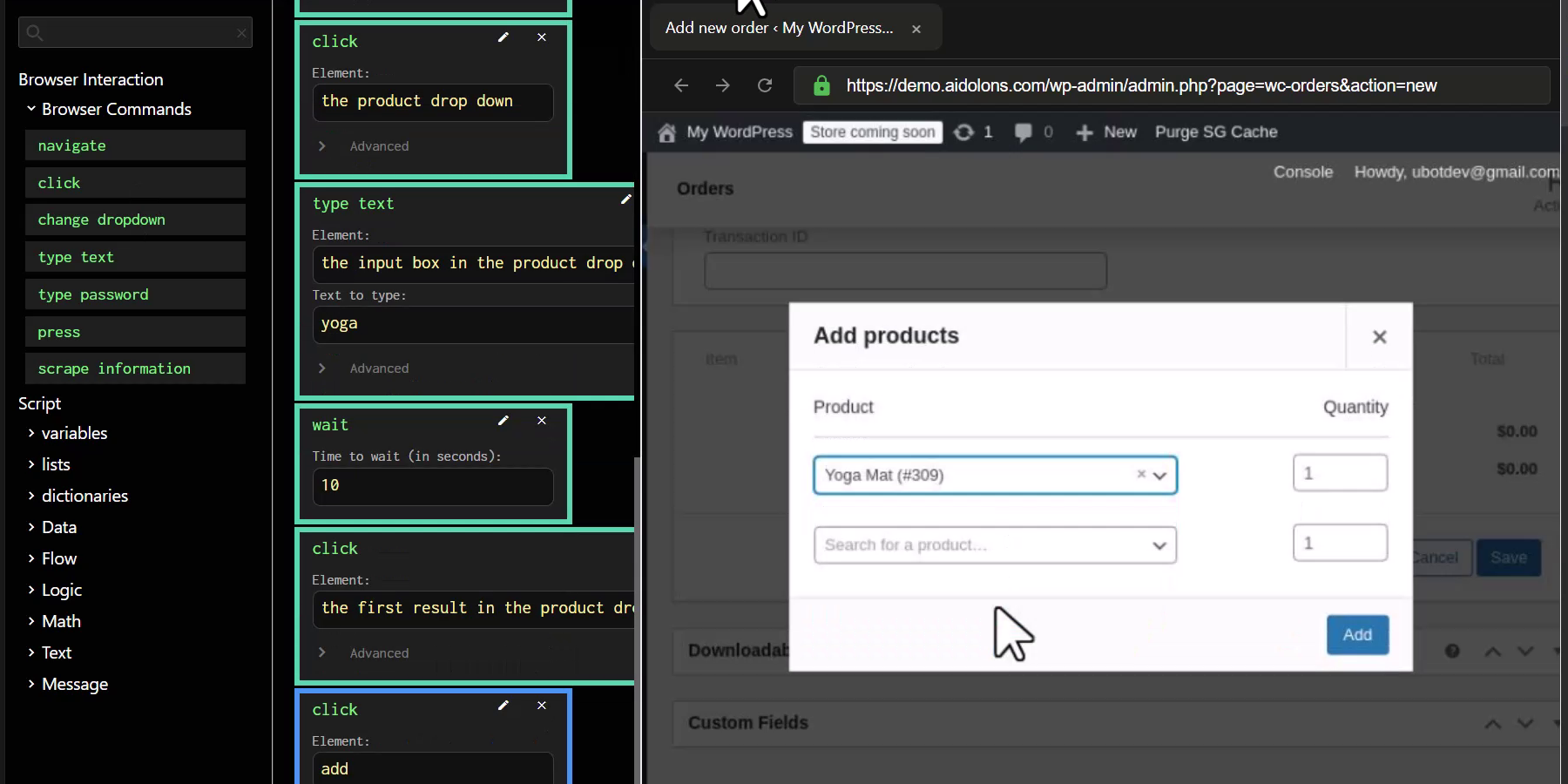
Aidolons Flow Editor showing drag-and-drop blocks automating an order creation screen

Why Aren't We All Using Agents Already?

We've heard people go on and on about how incredible agents are. So why aren't we all using them already?

Generic agents are probabilistic—they “think” they know which element is a dropdown, but sometimes they don’t. In reality, they're subject to all the same failings as any AI.

That’s fine for a party trick; not fine for payroll.

Aidolons.com layers deterministic logic on top of AI:

  1. Natural-language selectors (“the blue Save button”) become locked-in element IDs.
  2. Each step runs only after the previous one passes.
  3. You can loop, branch, or manipulate data, but every action remains explicit.

Result? If you're careful, you really can hit 100 % success on tasks.

“I stopped double-checking every scraped row. Aidolons.com hasn’t missed once in two months.” — Mark T., boutique agency owner


Five Surprising Jobs You Can Hand Off Today

TaskTime Saved / RunFlow or Agent?
Issue invoices from WooCommerce orders2–3 minAgent
Create new customer orders with multiple products10 minFlow
Bulk-edit Shopify product prices15 minFlow
Pull SEO metrics from three tools into one sheet20 minFlow
Copy Facebook leads into your CRM5 minAgent

(Imagine sipping coffee instead of babysitting those clicks.)


How We Kept It Simple for Non-Tech Folks

  • Plain-English commands. If you can write “click the green Publish button,” you can build a flow.
  • Instant test browser. See each step run in real time—no “deploy and pray.”
  • Natural-language element picking. Forget CSS selectors; just describe what you see.
  • No-code, but devs aren’t boxed out. Prefer Python? Use the SDK and still tap our AI element-finding magic. (Coming Soon)

A Peek Under the Hood (For the Curious)

  • Built-in SOTA models fine-tuned for automating tasks
  • Secure cloud browsers—nothing installs on your machine
  • Starts at $19/month; cancel any time

Ready to Reclaim Your Time?

Imagine opening your laptop tomorrow and finding:

✔️ Orders already processed
✔️ Reports neatly stored in Google Drive
✔️ 32 new leads sitting in your CRM—without a single copy-paste

That’s what early users are seeing, and we’d love for you to join them.

Yes, I’m ready to build my first flow »


Share the Love ❤️

Know a freelancer or store owner drowning in busywork? Forward this post or hit the share buttons—because no one deserves to spend another afternoon wrestling dropdowns.

Thanks for celebrating launch day with us. Can’t wait to see what you automate!

AI Writes Terrible YouTube Titles. Here's the 20-Minute Fix That Changes Everything

· 6 min read

(Watch the video above to see how one small change transforms AI from clueless to clickable)

Sign Up For Aidolons Now

Your AI assistant just gave you the most generic YouTube title ever written. Again.

"Introduction to [Topic]: A Comprehensive Guide" – because that's exactly what'll make people stop scrolling, right?

AI sucks at writing YouTube titles. At least, generic AI does.

But here's what nobody's telling you: The same AI that writes those terrible titles can become an expert YouTube optimizer with just 20 minutes of proper training.

In the video above, I transformed a basic AI agent into a specialized YouTube titler that actually understands what makes people click. The results? 10x better titles that invoke real curiosity instead of corporate blandness.

The Problem With Generic AI (And Why It Matters)

Last week, I built a YouTube manager agent. It could upload videos, set thumbnails, write descriptions – the works.

There was just one problem.

The titles were garbage.

Here's what it gave me for my AI art video:

  • Title: "AI-Generated Masterpiece: A Visual Journey"
  • Description: Started with the entire plot spoiler, then hallucinated fake actors, a fake art studio, and a fake writer

Generic. Boring. Zero clicks guaranteed.

The 20-Minute Solution That Changed Everything

Instead of accepting mediocre output, I did something different.

I taught my AI to actually understand YouTube.

Step 1: Deep Research (The Game-Changer)

I fired up OpenAI Deep Research – the most thorough research model available – and gave it this mission:

"Create a plain English, evidence-based guide for writing high CTR YouTube titles and descriptions. Use YouTube docs, credible creator write-ups, and 40-60 top videos. Evaluate using published A/B tests and cross-niche prevalence."

Twenty minutes later, I had a comprehensive guide based on:

  • Real A/B test results from successful creators
  • Cross-niche patterns that actually work
  • Character counts, hooks, and CTAs that drive clicks
  • Recurring patterns verified across at least 3 different niches

Not theories. Not guesses. Actual data from what works.

Step 2: Transform Research Into System Intelligence

Here's where most people mess up.

They get great research and then... nothing. They don't know how to make their AI actually use it.

The secret? System prompts with XML structure.

I wrapped the entire research guide in XML tags:

<title_and_description_writing_guide>
[Entire research document here]
</title_and_description_writing_guide>

Then added specific behavioral instructions:

  • Use video analysis tools to understand content
  • Generate 10 title options based on the guide
  • Collaborate with the user to refine
  • Never upload without explicit permission

That last one? Learned that lesson the hard way.

Step 3: Build a Micro-Expert, Not a Generalist

Companies keep trying to build AI that does everything.

They're doing it wrong.

What works? Micro-experts – AI agents that do one thing exceptionally well.

My YouTube Titler agent has exactly two jobs:

  1. Analyze videos
  2. Write titles and descriptions that get clicks

That's it. No bloat. No confusion. Just focused expertise.

The Results Speak for Themselves

Before specialization:

  • "AI-Generated Masterpiece: A Visual Journey" (yawn)
  • Description that spoils everything and makes stuff up

After 20 minutes of training:

  • "This AI Created a Movie About Itself (Why Are You Like This?)"
  • Description that teases without spoiling
  • Actual curiosity instead of corporate speak

The difference? One makes you scroll past. The other makes you click.

The Hidden Pattern Nobody Talks About

While building this, I discovered something fascinating.

AI doesn't naturally understand human psychology.

It understands language. It understands patterns. But curiosity? Emotional triggers? The gap between knowing and needing to know?

These are learned behaviors.

That's why generic AI writes like a textbook. It's trying to be comprehensive when it should be creating curiosity gaps.

The research phase isn't just about gathering information – it's about teaching AI what makes humans tick.

Your Next Move: Stop Accepting Mediocre AI Output

Here's what most people do:

  1. Ask AI for help
  2. Get generic output
  3. Shrug and use it anyway
  4. Wonder why nothing performs

Here's what you should do instead:

  1. Identify the specific expertise you need
  2. Research what actually works (not what sounds good)
  3. Build focused micro-experts for each task
  4. Iterate based on results, not assumptions

The Workflow That Actually Works

After testing dozens of approaches, here's the exact workflow that delivers:

For YouTube Titles:

  1. Analyze the video first (AI needs context)
  2. Generate 10 options (variety reveals patterns)
  3. Collaborate on refinement (human intuition + AI capability)
  4. Test the curiosity factor (would YOU click?)

For Descriptions:

  1. Tease, don't spoil (create anticipation)
  2. Front-load value (first two lines are crucial)
  3. Include clear CTAs (what should viewers do next?)
  4. Add timestamps (YouTube loves these)

The Critical Mistake to Avoid

Never let AI upload without your approval.

I learned this one the hard way. AI gets enthusiastic. It thinks it's done. It uploads your half-baked content to the world.

Always include explicit permission requirements in your system prompts. Trust me on this one.

Build Your Own YouTube Optimization Agent

The best part? You can build this yourself in Aidolons.

No coding. No complex setup. Just:

  1. Create your agent
  2. Add the research-based system prompt
  3. Give it video analysis capabilities
  4. Start generating titles that actually work

The whole process takes less than an hour, and you'll have a specialized assistant that outperforms generic AI every single time.

The Competitive Advantage Nobody's Using

While everyone else is using ChatGPT to write generic titles, you could have:

  • Specialized agents for each platform
  • Research-backed optimization built into every output
  • Consistent quality without constant prompting
  • Time savings that compound with every video

This isn't about AI replacing creativity. It's about AI amplifying what you already know works.

Ready to Stop Accepting Generic AI Output?

You've seen the difference specialized agents make. You know generic AI isn't cutting it.

The question isn't whether to specialize your AI – it's how quickly you can start.

Build your first micro-expert today. Your content performance will thank you.

Yes, I'm ready to build specialized AI agents »


P.S. That 20-minute research investment? It pays off every single time you create content. Build once, benefit forever. With Aidolons' 14-day guarantee, you can test this entire system risk-free.